
Laser Structuring
Laser materials processing is of great interest for industrial applications as well as for scientific investigations. Main advantages of the laser as a manufacturing tool are the high speed at which a laser beam can be moved and, contrary to mechanical tools, laser light is not subject to wear and tear. Besides the wavelength, the pulse duration of the laser source is the main parameter influencing the nature of the lasermaterial coupling. Pulse durations of down to a few femtoseconds are available from state of the art laser systems. The high peak intensities provided by ultrashort pulses initiate multiphoton absorption mechanisms, bridging a band gap much larger than the photon energy. Thus, by applying ultrashort pulses the ablation of nearly any material is possible by multiphoton absorption.
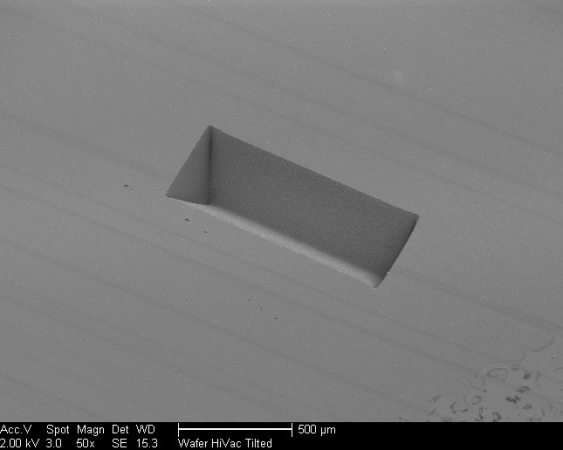
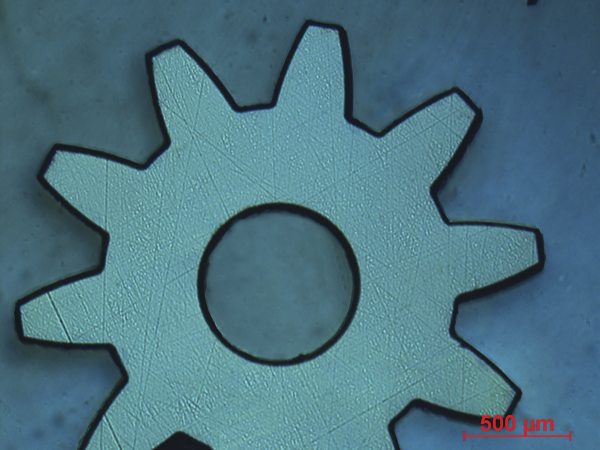
The non-thermal nature of ultrashort pulsed ablation together with the ultrafast mechanism offers well-defined ablation threshold fluences and enables laser structuring with high precision.
Structuring of Polymers (Sensors and Microfluidic Devices)
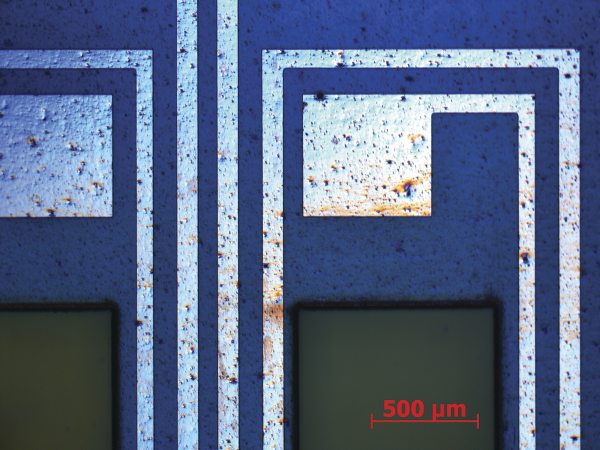
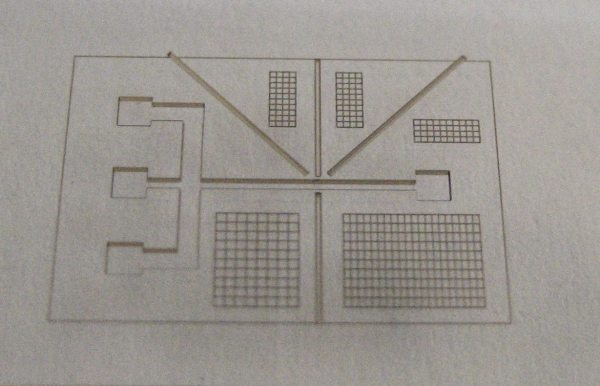
Thin Film Ablation (for Automotive Sensors)
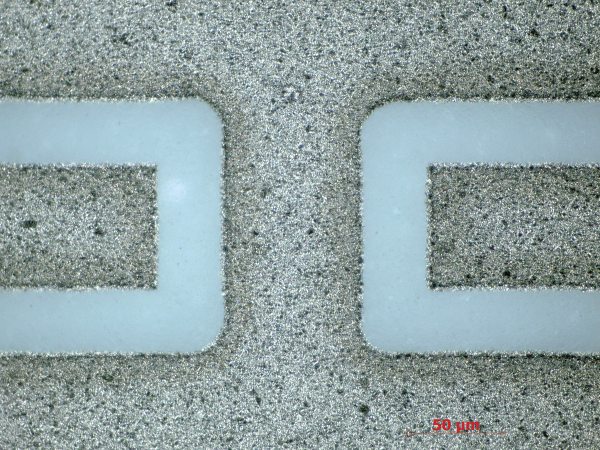
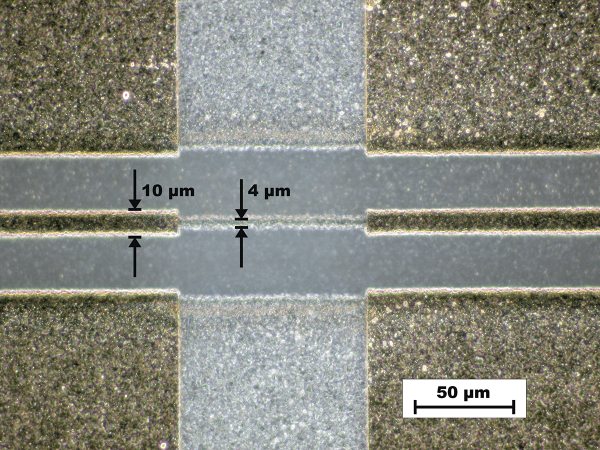
Surface Structuring of Glass and Cubic Silicon Carbide
Waveguide Writing
Microfluidic channels and patterns are typically fabricated by lithographic and chemical-etching techniques, but these approaches are primarily limited to the fabrication of two-dimensional patterns on the surface. Indeed, in order to create a true 3-D structure several layers of glass substrates need to be patterned, etched and fused together.
Femtosecond Laser Irradiation and Chemical Etching (FLICE) allows 3-D micromachining, thus permitting the direct fabrication of buried microchannels with various aspect ratios and patterns. Please see Application Focus 19 for additional information.
Fabrication of Optical Fiber Diffusors
Recently, an ablative femtosecond process for fabrication of a fiber diffusor has been developed at the research center for micro-technology at the Applied University in Dornbirn, Austria in collaboration with Spectra-Physics. A fiber diffusor is fabricated using the Spirit® 1040-8 SHG femtosecond laser from Spectra-Physics by creating a series of defects on the fiber’s surface (see Figures 2 and 3). These defects penetrate into the fiber’s core, inhibiting the total internal reflection at the interface between core and cladding so that the light is scattered and decoupled at the roughened surface. Please see Application Focus 25 for additional information.
Lasers for Ultrafast Pulse Material Structuring
| Description | Features | |||
|---|---|---|---|---|
 | IceFyre® FS UV and IR Femtosecond Lasers |
| | |
 | Spirit® High-Power Femtosecond Lasers |
| |